

AI is moving fast. The companies seeing real results are those making clear-eyed calls. They choose where to lead with AI, where to hold back, and where to step away entirely. Those decisions don’t stand on their own. They’re enabled by something deeper: A robust, adaptive architecture that allows AI to scale, integrate, and deliver measurable impact.
If your company is like most, your architecture wasn’t designed with industrial-grade AI in mind. It may struggle to deliver, quickly and at a reasonable cost, the governance, orchestration, workflow redesign, and user experience that dependable, repeatable AI demands. But with the right architecture, your enterprise can transform, workflow by workflow, until it becomes agentic: You can move from “artisanal” point solutions to an “industrial model,” where AI is embedded, at scale, into agentic workflows with the performance, user fluency, controls, and accountability that your stakeholders demand.
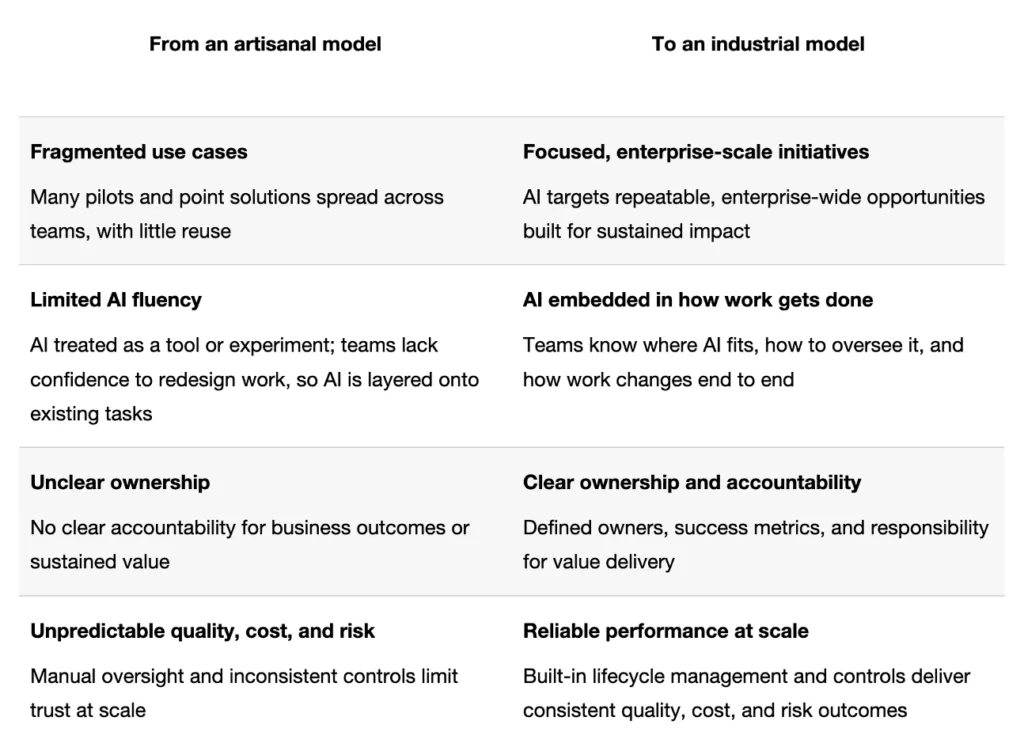
In an agentic workflow, agents don’t assist people. Work moves end-to-end through a governed system of specialized agents. Some execute. Others orchestrate or validate. Still others escalate decisions around exceptions, risk, or policy to the right people at the right time. A live view of outcomes, costs, and risks puts you in command.
This agentic architecture is not a rip-and-replace exercise. It can build on your existing core systems, but it still requires deliberate changes in design. Read this blog to learn all the details.